Our adventure in the Smokies began before we even reached the national park.
After a couple warm nights camping in Tennessee state parks, we decided to give ourselves a short reprieve and booked an Airbnb on the outskirts of Pigeon Forge. It sounded like a sensible idea until we arrived after 10 p.m. and discovered that the final approach was a steep, narrow, one-way mountain road. Negotiating the tight turns with a Suburban, teardrop trailer and two rooftop tents in tow was a little more adventure than we had planned. The silver lining was finally learning how to use the Suburban’s low gears.
The next morning we drove through Pigeon Forge and into Gatlinburg before entering Great Smoky Mountains National Park. It took us a surprisingly long time to get started. Seven people have an uncanny ability to turn a quick stop into a lengthy one, and before we’d even reached the trail we’d filled water bottles, wandered through the visitor centre and, for the first time in all our years of visiting national parks, had to purchase a Junior Ranger book for the children. In 32 national parks and as many national monuments and historic sites, all of the books had been *free (e.g., taxpayer subsidized) thus far.
Because Poky was travelling with us, our hiking choices were limited to one of the park’s dog-friendly walks near the two main visitor centers on the edges of the park. We started at Sugarlands Visitor Center, where even in the shade, the temperature was climbing towards 100°F. The youngest rascals weren’t convinced hiking was the best way to spend the morning. Poky enjoyed cooling off in the stream and Carolina led the return journey in search of a Mentos waiting back in the car.
From Sugarlands we followed Newfound Gap Road across the spine of the Smokies towards North Carolina, stopping to admire a few overlooks (but not too many, as loading and unloading is not a quick activity for us). Along the way we learned that the Appalachian Mountains were once taller than today’s Rockies before hundreds of millions of years of erosion slowly shaped them into the gentler mountains we see today. The ancient history of the mountains was quite the contrast to the gaudy castles, pirate ships and even upside-down buildings competing for attention in Pigeon Forge.
Our final stop at Oconaluftee Visitor Center aligned with the afternoon ranger presentation, held outside despite temperatures still consistently pushing 100°F. The ranger introduced us to one of the Smokies’ lesser-known claims to fame: the park is home to 31 species of salamanders, more than anywhere else in the world. Living in these cool, damp forests has allowed them to evolve in remarkable ways. Some of us learned, and others reminded, that all salamanders breathe entirely through their skin, without lungs or gills. These lovely guys range from 2 inches (pygmy) to 2 feet (the eastern hellbender), and can remain underground for months to years (!) at a time.
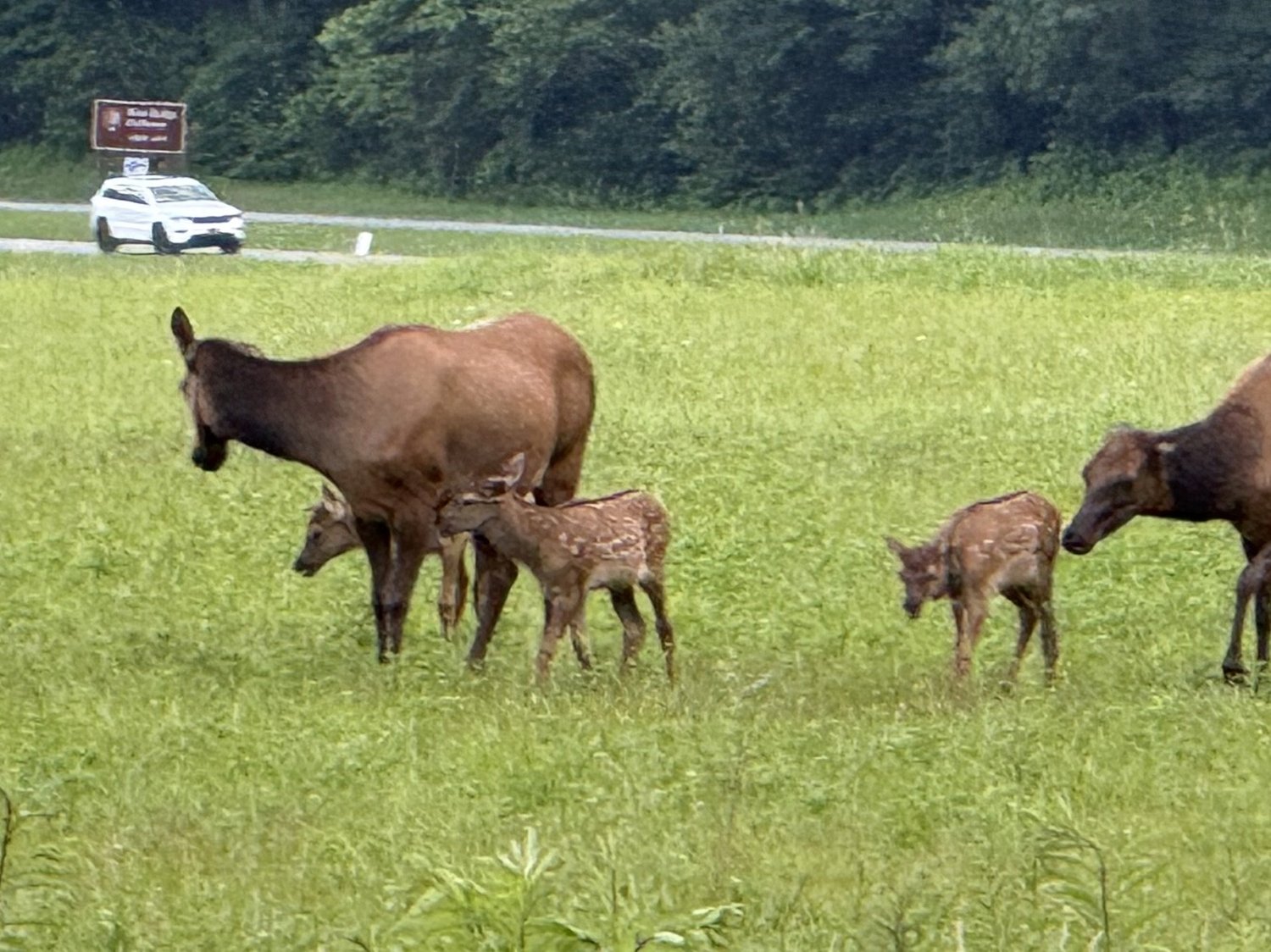
Walking back from the obligatory final bathroom stop before heading out of the park, we looked across the meadow to find a small herd of elk, including several calves, quietly grazing only a short distance away. The calves were still young enough to have spots and chasing their mothers across the meadow trying to nurse.
As we left the park we joined the very southern end of the Blue Ridge Parkway. We knew this could take us all the way to Shenandoah, but in our need to cover a lot of ground, we broke off after a few miles to find the interstate and the way to our campsite. We knew this was just a taste of the fresh breezes and swaying leaves along the Parkway; it would be a few hundred miles and another state border before we’d see the Blue Ridge again.
